When your hardwood floor starts to look worn, it's natural to wonder whether you should refinish it or replace it. In most cases, sanding and refinishing is the more affordable option, often by a wide margin. However, the best choice really depends on your floor's condition. Knowing what affects the costs for both options will help you make a decision based on your specific situation. If you're unsure, it's always a good idea to speak with a professional wood floor restoration expert before deciding to replace your existing floor.
The cost difference between sanding and refinishing an existing floor and replacing it entirely is substantial, and it catches many people off guard when they first look into it properly. Restoration involves labour, equipment and finishing materials applied to timber that is already in place. Replacement involves all of those things plus the cost of new timber, the removal and disposal of the existing floor, and subfloor preparation work that often throws up additional expense once the boards come up.
New hardwood flooring can be expensive, and cheaper options often don't match the quality of the wood found in older London homes. When you add up all the costs of replacing a floor, it usually ends up costing several times more than a professional restoration.
Many people think that restoring a floor is a compromise, but that's often not the case. Victorian and Edwardian pine and oak boards in older London homes were made from timber with a quality and character you can't find in modern flooring. The wood is denser, the boards are wider, and the look that comes with age can't be replaced. If you choose a new floor, you lose all of that for good.
Professional sanding removes years of damage, old finishes and dirt, revealing the wood as it was before it became worn. Applying a quality finish afterwards protects the surface and highlights the wood's natural grain and colour, giving it a character that new floors don't yet have.
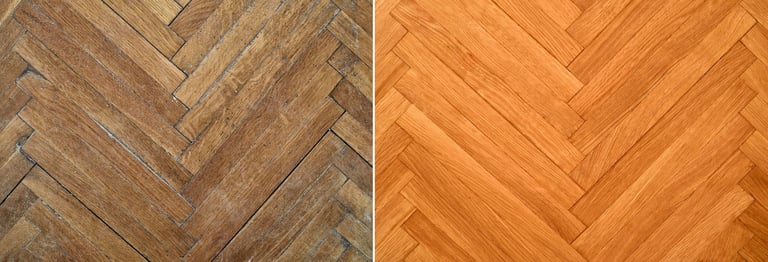
"Victorian and Edwardian pine and oak boards were made from timber with a quality and character you can't find in modern flooring. The wood is denser, the boards are wider — and that look can't be replaced."
Restoration is the right answer for the vast majority of hardwood floors, but it isn't the right answer for every floor in every situation, and being clear about that distinction is part of what genuine expertise looks like.
The main technical issue is whether the boards are thick enough for another sanding. Each restoration removes a bit of wood, and boards that have been sanded many times may be too thin for more work without risking their strength. This can't be judged from photos or just knowing the floor's age. An experienced professional needs to check the boards in person to see what's possible.
If the boards are still strong and thick enough, restoration is usually the best option. If there is more serious damage, things get more complicated. Localised rot, water damage or warped boards can often be fixed by replacing just those boards before sanding the whole floor, which is much cheaper than replacing everything and keeps the original character.
Can't be judged from photos or age alone. An experienced professional needs to check the boards in person to assess thickness, structural integrity, and what's truly possible.
It's worth being straightforward about the situations where replacement genuinely makes more sense, because the answer isn't always restoration.
Floors where the boards are too thin to sand again, too rotten to repair, or structurally compromised to the point of not functioning correctly are candidates for replacement rather than restoration. These situations are less common than people sometimes fear, particularly in older properties where the original boards were laid thick enough to withstand many restorations over a long life. But they do occur, and they deserve an honest assessment rather than a restoration attempt that won't last.
There are also cases where replacement is a design decision rather than a condition one. If someone wants a different species, a wider board format or an aesthetic that the existing floor simply can't deliver, replacement is the obvious route. That's a perfectly legitimate choice, but it's worth being clear that it's a preference rather than a necessity, particularly before committing to a cost that could be several times greater than the alternative.
"Replacement is a perfectly legitimate choice when it's a preference rather than a necessity — but it's worth being clear about that distinction before committing to a cost several times greater than restoration."
Besides saving money, restoration has environmental benefits that are often overlooked. Replacing a hardwood floor creates a lot of waste, new wood needs to be sourced and transported, and it means losing original material that may have lasted for a century or more. Restoring your floor uses fewer resources, creates much less waste and keeps the unique character of the old wood. If you care about sustainability, restoration is the much greener choice.
"Restoring your floor uses fewer resources, creates much less waste and keeps the unique character of the old wood. If you care about sustainability, restoration is the much greener choice."
Thinking about restoring rather than replacing your hardwood floors? Get in touch with the Quicksand Flooring team for a free assessment. We'll give you an honest evaluation of your floor's condition and clear advice so you can make the right decision with confidence.
Or email us at info@quicksandflooring.co.uk