When a commercial wooden floor starts to show its age – scratched, dull, uneven in places, or simply no longer presenting the business in the way it should – the instinct is often to replace it. Start fresh, choose something new, and draw a line under years of wear. It is an understandable response, but it is not always the right one.
In many cases, a professionally restored floor will perform just as well as a new one, be ready to use sooner, cause the business considerably less disruption and have a lower environmental impact. In others, replacement genuinely is the correct call, and a reputable contractor will tell you so, even when restoration is what they would prefer to sell you.
This guide gives commercial decision-makers in London an honest framework for evaluating both options. It covers what each process actually involves, how the two compare across the factors that matter most to a business, and how to know which answer is right for your specific situation.
Restoration is frequently misunderstood, described loosely as "sanding and varnishing" in a way that undersells both the process and the outcome. Understanding what it actually entails is a prerequisite for making a fair comparison with replacement.
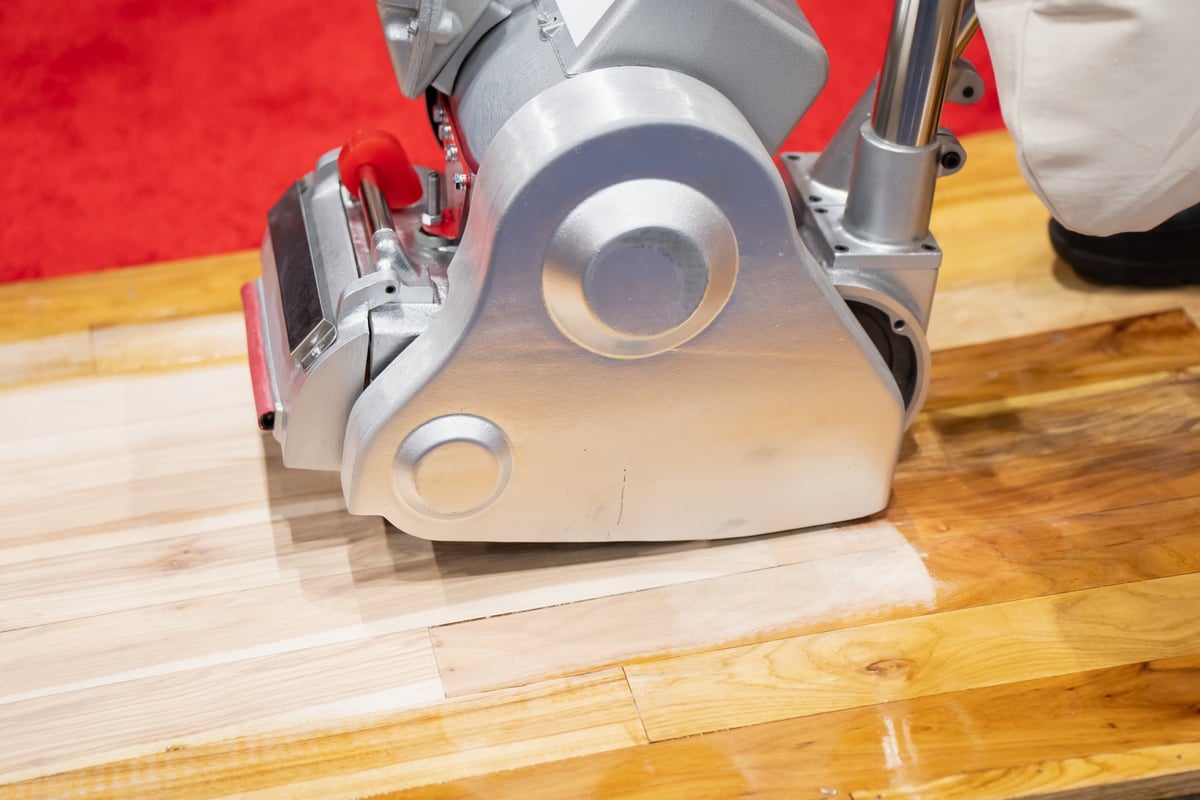
A professional commercial floor restoration begins with sanding – using calibrated sanding machinery to remove the worn surface layer of the wood, working through progressively finer abrasive grades until a smooth, consistent surface is achieved across the entire floor. This removes scratches, surface staining, uneven wear patches and the residue of old finishes that have degraded over time.
Alongside the sanding, any necessary repairs are carried out. Damaged or loose boards are replaced or resecured. Gaps between boards are filled using sliver filler made from reclaimed timber, which expands and contracts with the wood rather than shrinking or discolouring over time. Sections that have become uneven are levelled. The result, before any finish is applied, is a structurally sound, uniformly prepared surface.
The finish is then applied in multiple coats, each allowed to dry before the next is applied. For commercial environments, the finish specification matters enormously. Commercial-grade lacquers, hard wax oils, and specialist coatings such as Bona Resilient Flooring are formulated to withstand sustained heavy footfall, rolling loads, and the daily demands of a working commercial space in ways that domestic products simply are not.
The outcome of a properly executed restoration is a floor that looks new, performs to commercial standards and has had its usable lifespan meaningfully extended. It is not a patch-up or a cosmetic fix; it is a full reset of the existing floor's surface and protective layer.
Replacement is equally worth understanding in full, because the scope of the process is often underestimated at the point of decision.
Full floor replacement begins with the removal of the existing floor – a process that is noisy, generates significant debris, and requires the affected area to be completely cleared before work can begin. Depending on the type of floor and how it was originally installed, removal can be straightforward or highly disruptive. Glued-down parquet or hardwood, for example, takes considerably more effort to remove than a floating floor system.
Once the existing floor is out, the subfloor must be assessed and, in many cases, prepared before new flooring can be laid. Subfloor levelling, damp-proofing, or structural repairs may be required; these costs and timescales are not always apparent before the existing floor is removed. This is one of the areas where replacement projects most commonly overrun both budget and timeline expectations.
New flooring is then installed. For commercial settings, the options include solid hardwood, engineered hardwood, luxury vinyl tile (LVT) and specialist commercial resilient flooring. Each has different installation requirements, drying or settling periods and considerations for when the floor is ready to bear commercial footfall.
Throughout all of this, the affected area is entirely out of use. Unlike restoration, which can often be phased or scheduled to minimise disruption, full replacement typically requires a complete and extended closure of the affected space.
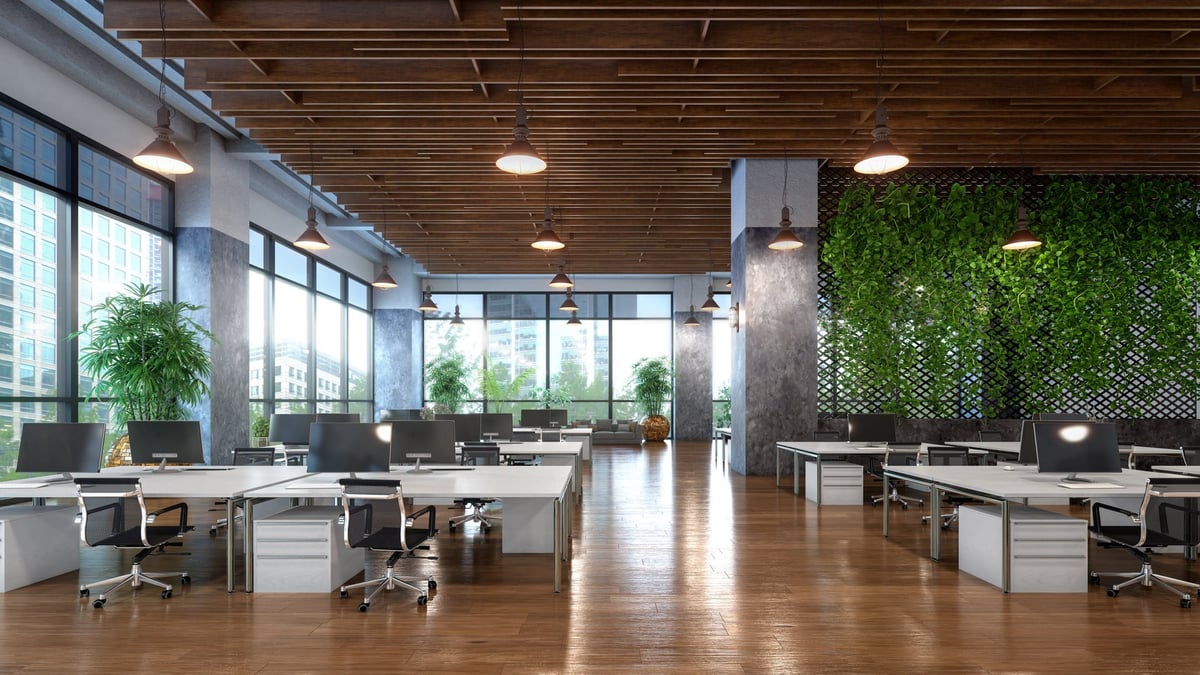
A professional floor restoration can typically be scheduled overnight, over weekends, or in phases to minimise operational disruption. A business that closes on Friday evening can often return to a fully restored floor on Monday morning.
Replacement has a fundamentally different disruption profile with extended strip-out, subfloor preparation, and installation phases that extend closure considerably.
Board integrity: Boards must be structurally sound – not warped, split, or compromised by rot or damp. Surface damage does not affect structural integrity.
Remaining timber depth: Hardwood floors can only be sanded a finite number of times. The usable depth needs assessment by an experienced surveyor.
A professionally restored hardwood floor, finished to commercial specification and properly maintained, will perform well for a significant period. A newly installed floor will have comparable forward lifespan only if correctly specified and properly installed.
Longevity for both options is largely a function of post-project maintenance.
Restoration preserves the embodied carbon of the existing floor. No new timber is required and no material goes to landfill. Replacement involves the full carbon cost of producing and installing new materials.
For businesses with ESG commitments, restoration makes a strong sustainability case when the floor supports it.
Restoration transforms through staining and finish selection but cannot change the underlying material or format. Replacement opens the full range of available options for a fundamentally different look.
Restoration, particularly overnight or over a weekend, typically returns a floor to use much more quickly. Strip-out, subfloor preparation, installation, and curing requirements of replacement add up to a longer timeline.
Restoration is the appropriate choice when:
The existing floor is structurally sound, with boards or blocks that are intact and not warped or compromised by damp.
There is sufficient timber depth remaining to support sanding.
The damage is surface-level rather than structural.
Minimising downtime and operational disruption is a priority.
The business has sustainability commitments that favour preserving the embodied carbon of the existing floor.
The desired aesthetic outcome can be achieved within the existing floor, through staining and finish selection.
Replacement is the appropriate choice when:
The floor is structurally compromised beyond the scope of repair work.
The floor has been sanded to the limit of its usable timber depth, leaving insufficient material for further sanding.
The subfloor has been damaged and requires remediation regardless, making strip-out the logical next step.
The business requires a fundamentally different aesthetic that the existing floor cannot deliver, whatever its condition.
The floor is part of a broader refurbishment that changes the space's layout or configuration, making a like-for-like restoration impractical.
A contractor who recommends restoration when replacement is clearly the right answer is not acting in the client's interest. At Quicksand Flooring, the starting point is always an honest assessment of what the floor can and cannot support.
Neither restoration nor replacement can be properly evaluated without a physical assessment of the floor by a qualified and experienced professional. This is not a formality; it is the foundation of any reliable recommendation.

A site survey for a commercial floor project covers:
What a survey cannot be replaced by: a photograph, a description over the telephone, or an online enquiry form. Commercial floors present variables that are only apparent in person, and a specification based on incomplete information is a specification built on guesswork.
The outcome of a thorough survey is a clear, evidence-based recommendation (restoration or replacement, with the reasoning explained) along with a detailed scope of work for the recommended option. A business that commissions a survey is in a far stronger position to make a well-informed decision than one that proceeds on assumptions.
If your commercial floor is giving cause for concern, whether the problem is surface wear, structural damage, or simply uncertainty about the right course of action, the most useful thing you can do is arrange a site survey.
Quicksand Flooring offers free, no-obligation surveys across London and the Southeast, seven days a week. Our team will assess the floor honestly, explain what it can and cannot support, and give you a clear recommendation with the reasoning behind it.
Or email us at info@quicksandflooring.co.uk