Corridors and guest rooms are where hotel floors quietly wear out — and where a badly planned project can cost you the most in lost inventory. Here's how to restore them while the hotel keeps selling.
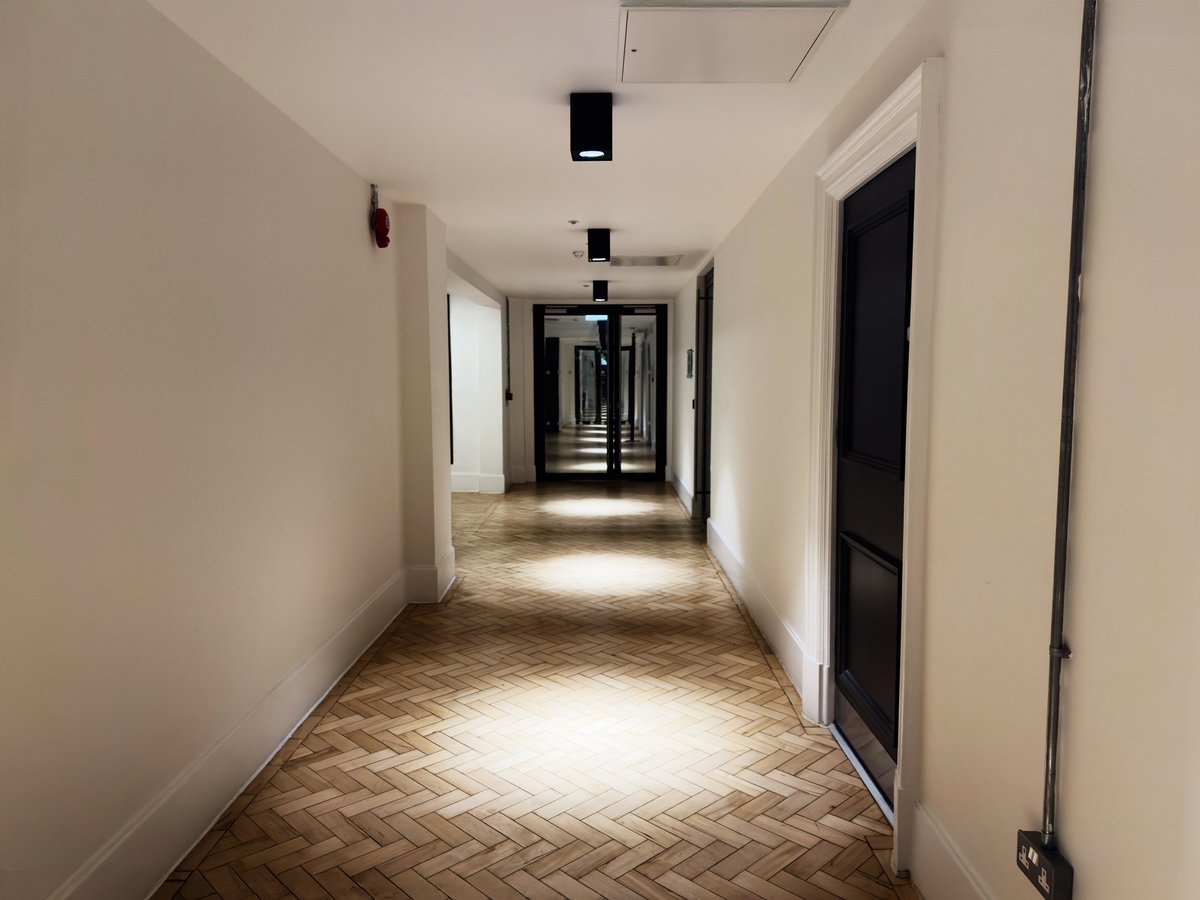
You can restore hotel corridor and guest room floors without losing significant room nights by phasing the work floor by floor, timing it for lower occupancy and choosing the right level of treatment for each area. Many corridors only need a screen and recoat rather than a full sand, which is quicker, quieter and keeps rooms out of inventory for far less time. With a clear plan agreed with your operations team, hotel and hospitality floor restoration can run in the background while the hotel keeps trading.
Corridors rarely get the attention the lobby does, yet they take a remarkable amount of punishment. Every guest walks the same route from the lift to their door, usually pulling a wheeled case. Housekeeping trolleys, room service trolleys and maintenance equipment follow the same line several times a day.
The result is a distinct traffic lane down the middle of the corridor, where the finish wears through long before the edges show any sign of age. Lift lobbies and the stretch outside the service lift are usually the worst. Because corridors are often dimly lit, the wear can creep up unnoticed until a guest review or a brand inspection points it out.
One lane, thousands of passes
Because traffic concentrates in a single lane rather than spreading across the floor, corridors reach the point of needing a recoat far sooner than open areas of the same age. Catching it early is what keeps the job small.
If you've already put a plan in place for your entrance, our guide to hotel lobby floors and the busiest floor in the building covers the same principles, from finish choice to matting.
Inside the rooms, wear tends to concentrate in a few predictable places rather than spreading evenly across the floor.
The first metre takes grit and moisture off every shoe that enters the room.
Hard castors grind through a finish surprisingly quickly in a tight arc.
Cases dragged in and out mark the same patch of floor repeatedly.
Wet feet and cleaning can grey the timber at the edges once the finish thins.
Most of this can be managed with soft castors, a properly placed luggage rack and a finish suited to the cleaning regime. Once the timber itself is exposed, though, restoration is the only way to bring the floor back.
Overnight working suits lobbies, restaurants and function rooms well, because nobody is trying to sleep next to them. Corridors are different. Full sanding is noisy, and doing it outside occupied rooms in the early hours simply isn't acceptable to guests.
Corridors also form part of your fire escape routes. Any work has to keep a safe, agreed route available at all times, which means planning closures with your fire risk assessment in mind rather than around it.
Sanding machinery outside occupied rooms in the early hours isn't acceptable to paying guests, whatever the operational logic.
A safe, agreed route has to stay available at all times, so closures are planned around your fire risk assessment.
That's why corridor and guest room projects usually rely on a different approach from the overnight working we use elsewhere in hotels.
The answer isn't to accept a wing of closed rooms. It is to use all three of the following together, matched to the condition of each area.
Taking one floor or one wing out of inventory at a time, ideally during a quieter trading period, lets us work during the day without disturbing guests. The rest of the hotel continues as normal, and each section is handed back before the next one closes.
If the finish is worn but the timber underneath is still sound, a screen and recoat is often all that's needed. The existing finish is lightly abraded and a fresh coat applied over the top. It's much quieter than full sanding, takes a fraction of the time and keeps rooms out of service for far less. It also costs considerably less, which makes it ideal as a regular maintenance step.
Rooms or corridor sections where the finish has worn right through or the timber is damaged can be scheduled for full restoration in the same phase. This keeps the more disruptive work to the minimum area possible.
Guests in neighbouring rooms and on other floors shouldn't notice we're there. We use waterborne finishes with low odour, and our sanding equipment captures dust at source rather than letting it travel through corridors or into air handling systems. You can read more about how we manage this in our article on dust-free commercial sanding and indoor air quality.
Agreed before the first machine starts
We agree working hours, noise windows and access routes with your general manager and head of housekeeping before work begins. Housekeeping can then plan room turnarounds around our programme rather than the other way round.
For corridors and guest rooms, the finish needs to cope with heavy rolling loads, frequent vacuuming and the cleaning products your housekeeping team uses. A two-component waterborne lacquer is usually the right specification, offering strong abrasion resistance and a consistent appearance.
Handles heavy rolling loads from trolleys and cases.
Tolerates the cleaning products housekeeping actually uses.
Consistent appearance from floor to floor and room to room.
If you operate more than one property, it's worth using the same products and specification everywhere so that rooms and corridors look consistent across the group. Our guide to managing floor restoration across a hotel group explains how to keep standards aligned across several sites.
The most cost-effective approach is to recoat corridors before the traffic lane wears through to bare timber. Once that happens, a full sand is the only option. A scheduled maintenance programme, typically with a recoat at agreed intervals based on footfall, keeps the floor looking consistent and avoids the bigger project altogether.
Ask about a maintenance programmeIf your corridors or guest rooms are starting to show wear, we can survey the floors and recommend a phased plan that keeps rooms selling. We offer free, no-obligation surveys across London and the Southeast. Call us on 0800 917 7770 or email info@quicksandflooring.co.uk.