Wooden floors are one of the most valuable assets in a commercial space. They set the tone for how a business presents itself — to clients, customers, staff — and when they are well maintained, they do that work quietly and effectively. When they are not, the damage to first impressions is immediate and difficult to ignore.
The trouble is that the prospect of commercial floor sanding puts many businesses off. The assumption, not entirely without foundation, is that the process is disruptive, messy and incompatible with premises that need to keep functioning. In practice, with the right contractor and proper planning, most London businesses can have their floors fully restored without losing a single day of trading. This guide explains how.
It is worth being clear about this distinction upfront, because it affects every decision that follows, from the job specification to scheduling, the equipment used and the contractor you choose.
A residential floor sanding project is largely a question of skill and materials. The homeowner moves out of the room, the contractor gets to work, and the main considerations are finish quality and drying time. Commercial work is fundamentally different in almost every respect.
Commercial floor areas are typically larger, demanding more resources, more planning and greater complexity in sequencing the work. A 500m² office floor is not simply five times the work of a 100m² flat.
Out-of-hours working requires coordination of keyholding, alarm codes and building access protocols — often involving building managers or landlords.
Dust can contaminate food areas, settle on IT equipment, and present hygiene issues. Commercial-grade dustless sanding equipment is not optional — it is the baseline.
Commercial-grade coatings are engineered to withstand constant footfall, heavy furniture, wheeled equipment and sustained daily wear.
Commercial clients need contractors who carry appropriate accreditations and insurances. SMAS Worksafe accreditation, for example, is a recognised health and safety standard that gives commercial clients confidence in a contractor's on-site practices. It is a credential that matters when a facilities manager is completing a procurement form.
This is the question that sits at the front of every commercial buyer's mind, and it deserves a direct answer — even if that answer involves variables.
The larger the space, the longer the project. More coats of finish need to be applied and dried in sequence, which extends the overall timeline independently of the sanding phase.
A well-maintained floor requires fewer passes and less remedial work. A neglected floor with deep scratches, uneven sections or significant contamination takes considerably longer.
Commercial floors typically require more coats than residential ones — a primer coat followed by three or more topcoats is standard for high-traffic applications.
These are not the same thing. A floor may be dry enough to walk on within hours, but full curing — the point of maximum hardness — takes considerably longer. A good contractor will advise on each stage.
A pre-visit site survey by an experienced contractor is the only reliable way to get an accurate timeline for a specific project. Any contractor offering a firm timescale without having seen the floor should be treated with caution.
The good news is that experienced commercial floor contractors have developed scheduling models specifically to address the disruption concern. The right approach depends on the type of business, the layout of the premises, and the operational constraints involved.
The most common solution for businesses that trade during the day. The contractor works through the night, completing the restoration before the building reopens.
Preferred by many clients — allows more consecutive working hours. A long weekend can accommodate a complete restoration from sanding to final coat.
The floor is divided into zones, each restored sequentially. Completed areas are returned to use while the next section is worked on — ideal for hotels, large offices, or schools.
The most cost-effective approach. Seasonal closures, summer shutdowns and annual refurbishment windows are natural opportunities to schedule restoration.
Quicksand Flooring has been operating across London and the Southeast since 2006, and out-of-hours commercial working — overnight, weekend and phased — is a standard part of how the business operates, not an exception. The National Theatre is among the commercial clients for whom the team has carried out restoration work.
Dustless floor sanding deserves its own section in any guide aimed at commercial buyers, because the implications of dust in a commercial environment are quite different to those in a domestic one.
The sanding process removes the surface layer of the wood, and without extraction equipment, the fine dust produced spreads widely throughout the space — and beyond. In an open-plan office, this means dust settling on desks, screens, keyboards and documents. In a food business, it creates hygiene risks that are incompatible with even temporary trading. In a retail space, it coats displayed stock.
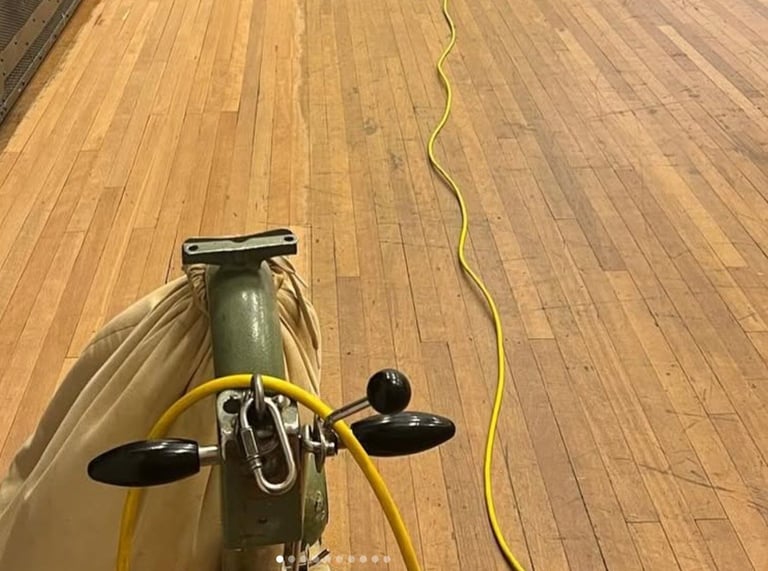
Modern dustless sanding equipment — Quicksand Flooring uses machinery from Lägler, the German manufacturer widely regarded as producing the industry's leading sanding equipment — extracts the vast majority of dust at the point of generation, feeding it directly into collection units rather than allowing it to become airborne.
The difference in residual dust between dustless and standard sanding is significant. For commercial clients, this translates directly into faster return-to-use, lower post-project cleaning requirements, and compatibility with environments where dust cannot be tolerated.
It is worth asking any prospective contractor specifically about their extraction equipment. Dustless sanding is not simply a matter of having any extraction unit attached to a sander; the quality and capacity of the equipment matter, and the difference between entry-level and professional-grade extraction is meaningful in a large commercial space.
For commercial buyers who have not been through this process before, knowing what to expect at each stage reduces uncertainty and makes planning considerably easier.
A professional commercial contractor will always carry out an in-person survey before quoting. This allows them to assess the floor area accurately, identify damage or repairs required, evaluate the condition and thickness of the existing boards, and understand the access and scheduling constraints of the premises.
Following the survey, the contractor will confirm the scope of work, the recommended finish specification, the scheduling approach, and any requirements from the business side in terms of preparation. This is the point at which access arrangements and third-party approvals should be confirmed.
Before the contractor arrives, the floor area needs to be cleared — furniture, equipment, loose cables, and any items stored on the floor. In phased projects, this may apply to one zone at a time.
The restoration begins with sanding — starting with a coarser abrasive to remove the old finish and surface damage, working progressively through finer grades. Repairs such as replacing damaged boards, filling gaps, and levelling uneven sections are carried out as part of this phase.
Once the floor is sanded to the required standard, the finish coats are applied in sequence. Each coat is allowed to dry before the next is applied. The number of coats depends on the finish specified and the demands of the environment.
The contractor will advise on when the floor can be walked on, when furniture can return, and when the floor has fully cured. At handover, a well-organised contractor will also provide aftercare guidance: how to clean the floor, what products to use, and when to book the next maintenance visit.
Not all floor sanding companies are equipped for commercial work, even if they describe themselves as such. The following questions help to separate experienced commercial contractors from those whose primary expertise lies in domestic projects.
Ask for examples: named clients, case studies, or references from businesses similar to yours in sector and scale.
This should be standard practice for any contractor serious about commercial work. If it is offered as a premium or exception rather than a default, treat that as a signal.
SMAS Worksafe and equivalent contractor health and safety schemes are the relevant standard for commercial environments. A contractor without recognised accreditation is a risk in any managed or regulated premises.
Professional-grade dustless sanding equipment is the baseline for commercial work. If a contractor cannot name their equipment or is vague about their extraction capability, press for more detail.
Accountability in commercial settings depends on knowing who is on your premises. Quicksand Flooring employs its team directly and does not subcontract — a straightforward but significant point of difference in an industry where labour is frequently outsourced.
A reputable contractor will have a clear position on remedial work and aftercare. Understand what is and is not covered before you sign anything.
The right starting point for any commercial floor restoration project is an in-person survey. It costs nothing, creates no obligation, and is the only reliable basis for an accurate specification and timeline.
Quicksand Flooring offers free, no-obligation surveys across London and the Southeast, seven days a week. Our team will assess the floor honestly and give you a clear recommendation with the reasoning behind it.
Or email us at info@quicksandflooring.co.uk